


In this post


Choosing the best CMMS software for the food industry starts with understanding the cost of getting maintenance wrong. A single hour of unplanned downtime can cost a food or beverage plant anywhere from $4,000 to $30,000 before you factor in scrapped product, sanitation rework, delayed shipments, and lost production time.
Recent research also found that food and beverage is now the only manufacturing sector where unplanned downtime hours continue to rise, pushing annual downtime costs beyond $10 million per plant. As Food Industry Executive noted, "Food and beverage is the only manufacturing sector to experience an increase in downtime hours over the past five years," making maintenance performance a growing business concern rather than a routine operational challenge.
Companies across the food and beverage industry operate under maintenance demands that many other industries don't face. Maintenance work has to fit around production schedules and sanitation windows while supporting food safety, audit readiness, and equipment reliability. Those realities make it harder to evaluate CMMS (Computerised Maintenance Management Systems) software for the food industry, especially when many platforms offer similar feature lists.
This guide focuses on the evaluation criteria that matter most for food plants, helping you choose a system that supports reliable maintenance operations today and gives your team room to grow over time.
Why food & beverage manufacturers need more than a basic CMMS
Food and beverage manufacturers operate in an environment where maintenance has to be carefully coordinated with production. Equipment such as refrigeration systems, fillers, conveyors, and packaging lines must be kept running reliably, while preventive maintenance often has to fit within narrow sanitation windows, allergen changeovers, planned shutdowns, and other periods when equipment is available for service.
Maintenance teams also need reliable documentation for inspections, repairs to food-contact equipment, and activities tied to Good Manufacturing Practices (GMPs). During FDA inspections and customer audits, teams may need to retrieve equipment histories and maintenance records that show what work was completed, when it was performed, and what corrective action followed an inspection.
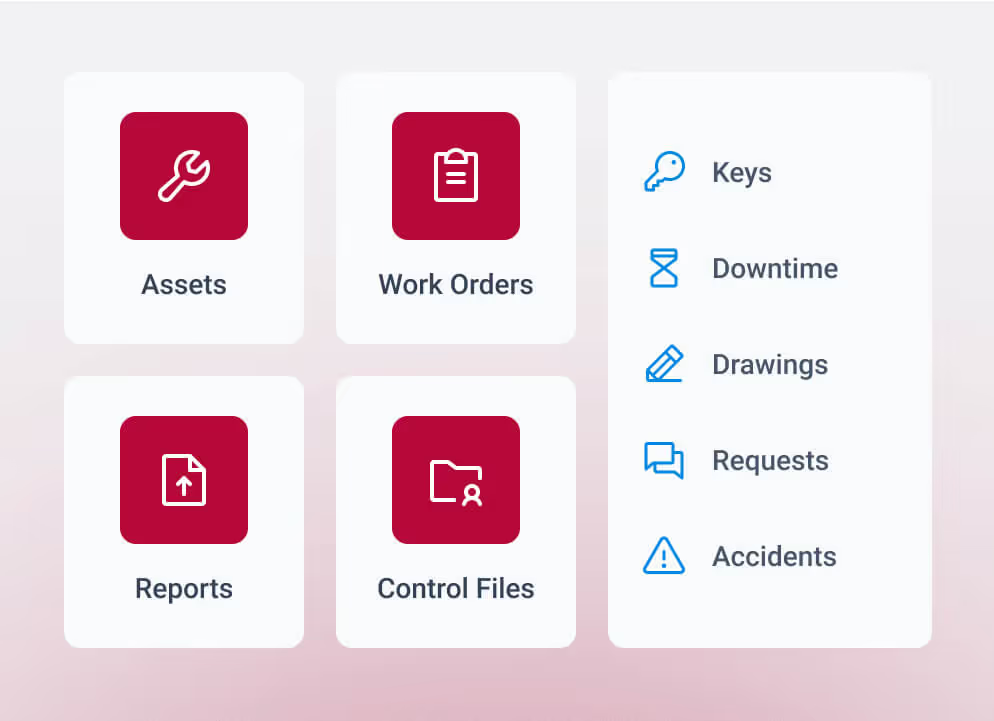
Spreadsheets, paper records, and basic maintenance tools can make it difficult to manage those workflows in one place. Food & beverage CMMS software can bring preventive maintenance, asset management, inspections, inventory, mobile workflows, and maintenance records together, giving teams better visibility into equipment history and day-to-day maintenance activity.
Those capabilities are most valuable when technicians use the system consistently, making usability a critical part of the CMMS evaluation.

Start with the real problem: technician adoption, not the feature list
The maintenance challenges unique to food and beverage plants make one question more important than any other during a CMMS evaluation: Will technicians actually use it?
According to Food Industry Executive's 2026 State of Industrial Maintenance report, 36% of maintenance leaders said labor shortages contributed to rising downtime, while 28% pointed to skills gaps. Most maintenance teams don't have extra capacity to work around software that slows them down. Every additional screen, manual step, or confusing workflow increases the likelihood that maintenance records will be skipped or completed later from memory.
Food plants add another layer of complexity. Technicians move between production lines, work around sanitation schedules, and often complete maintenance during planned shutdowns or overnight shifts. Documentation has to be quick, even when technicians are wearing PPE or working in washdown environments. When recording work becomes difficult, maintenance records become incomplete, inventory usage is less accurate, and equipment histories become less useful for planning repairs, budgeting, and asset replacement.
The same report highlights another common challenge. While 64% of organisations report having a preventive maintenance program, half spend less than 40% of their maintenance time on planned work. Maintenance software should help technicians stay focused on planned work rather than adding unnecessary administrative effort.
For that reason, usability deserves as much attention as functionality during vendor evaluations. Ask technicians to participate in demonstrations instead of leaving the evaluation to maintenance leadership, IT, or procurement. Have them complete everyday tasks such as closing a work order, recording labor, issuing parts, documenting an inspection, and finding an asset history. Those workflows provide a much clearer picture of how the system will perform after implementation than a polished product demonstration.
MEX was built around those day-to-day maintenance workflows. Mobile access, an intuitive mobile app, offline capability, simplified navigation, and role-based screens help technicians document work efficiently without disrupting production. Higher adoption leads to more complete maintenance records, stronger reporting, and greater confidence in maintenance decisions.
Once technicians can confidently use the system, the next step is evaluating whether its capabilities support your maintenance program. Focus on functionality that improves reliability, supports food safety, and fits the way your plant operates every day.
What capabilities should a food & beverage CMMS have?
Once you've established that technicians will actually use the system, the next step is evaluating whether the platform supports your operation. The best CMMS software for the food industry combines preventive maintenance, inventory management, mobile accessibility, reporting, and compliance tools that improve reliability while supporting food safety requirements. Each capability should solve a practical maintenance challenge your team faces every day.
Preventive maintenance for production-critical assets
Food plants depend on equipment that often has little tolerance for unexpected downtime. Fillers, conveyors, mixers, refrigeration systems, packaging lines, pasteurisers, pumps, and clean-in-place (CIP) systems all require consistent preventive maintenance to avoid disruptions that affect batch production, product quality, and customer deliveries.
Look for a CMMS that supports flexible preventive maintenance schedules based on time, runtime, meter readings, or production cycles. Equipment histories can also support predictive maintenance by helping identify developing issues before they lead to unplanned downtime. Scheduling tools should allow maintenance managers to plan work around sanitation windows, allergen changeovers, and planned production shutdowns while providing complete equipment histories that help technicians identify recurring failures before they become larger reliability issues.
Compliance and food safety
Maintenance records can support FDA inspections, customer audits, and food safety programs by making relevant equipment and maintenance history easier to retrieve.
A CMMS can centralise records related to preventive maintenance, equipment inspections, calibration, sanitation activities, HACCP programs, and food-contact equipment. While the CMMS itself does not ensure compliance, it can help teams document maintenance activities and corrective actions in one place.
Parts and inventory control tied to work orders
A missing spare part can bring an entire production line to a standstill. Waiting even a few hours for a replacement motor, gearbox, bearing, or refrigeration component can delay production, increase overtime, and create costly bottlenecks.
Evaluate how the CMMS manages inventory alongside maintenance work. Parts should be reserved directly against work orders, tracked as they're consumed, and connected to purchasing workflows when stock reaches minimum levels. This reduces stockouts while giving maintenance and finance a clearer picture of equipment costs.
Mobile work order management
Maintenance happens across packaging lines, refrigerated storage, warehouses, utility spaces, outdoor equipment, and quality assurance areas. Many tasks take place during sanitation shutdowns or overnight production windows where every minute counts. A mobile CMMS should make documentation quick and practical in each of those environments.
Technicians should be able to open work orders, review asset history, document repairs, capture photos, complete inspections, and close work without leaving the equipment they're servicing. Offline capability also matters in facilities where Wi-Fi coverage isn't available in every part of the plant. Maintenance work shouldn't stop because a technician temporarily loses connectivity.
Reporting and analytics
Maintenance leaders need CMMS reporting that supports better maintenance decisions.
Look for reporting that answers questions like:
- Are preventive maintenance tasks being completed on schedule?
- Which production lines or packaging areas generate the most emergency work?
- Which assets experience recurring failures?
- Where is maintenance spending increasing?
- How old is the current work order backlog?
- Which equipment creates the highest maintenance costs?
These reports help maintenance teams identify trends, support asset management decisions, prioritise improvements, and justify budget requests with reliable data.
These capabilities provide a practical framework for evaluating CMMS platforms.
A step-by-step framework for choosing your CMMS
You should now have a clear picture of the capabilities your operation needs. The buying process is about determining which platform can deliver those capabilities in your environment. A successful CMMS selection starts with understanding your maintenance goals, evaluating software against real operational needs, and considering the long-term operational value each platform can deliver.
Step 1: Assess your maintenance challenges and business goals
Before comparing vendors, take time to understand the problems you're trying to solve.
Start by mapping your maintenance process from beginning to end. Identify your most critical production assets, review where preventive maintenance breaks down, document sanitation and production changeover requirements, note the audit records your team needs to maintain, and rank equipment based on asset criticality.
Once you've identified those gaps, establish measurable business goals for the evaluation. Those goals might include improving preventive maintenance compliance, reducing emergency work, shortening downtime, increasing technician productivity, or improving audit readiness. Clear objectives make it much easier to evaluate whether a vendor's capabilities support the outcomes your operation expects.
Step 2: Identify the capabilities your operation requires
Once you've identified your maintenance challenges, prioritise the capabilities that directly address them.
Separate your requirements into two lists: must-have capabilities and nice-to-have features. For many food manufacturers, preventive maintenance scheduling, inventory management, mobile work orders, inspections, compliance documentation, and reporting belong in the first category. Features that don't solve a meaningful operational problem can move to the second.
Focus on the capabilities your maintenance team will actually use every day. Software that fits your workflows consistently delivers more value than a longer feature list.
Step 3: Compare vendors based on usability, scalability, and implementation
This is where many buying teams focus too heavily on presentations instead of practical use.
Ask vendors to demonstrate common maintenance tasks using realistic scenarios. Have technicians close a work order, complete an inspection, reserve inventory, record labor, locate an equipment history, and perform preventive maintenance. Those workflows reveal how the system performs during day-to-day operations and give technicians an opportunity to identify potential friction before implementation.
Consider asking vendors:
- How long does a typical implementation take?
- How much configuration is required before go-live?
- How is historical maintenance data migrated from spreadsheets or legacy systems?
- How does the mobile application work when connectivity is limited?
- Can the platform integrate with ERP or purchasing systems?
- How much ongoing administration or IT support is required?
- Can we start with one plant and expand across multiple sites?
- What onboarding, training, and ongoing support are included?
Different stakeholders evaluate the platform differently. Maintenance leaders focus on operational fit, technicians on usability, executives on business impact, and IT on implementation, integrations, security, and ongoing administration.
Step 4: Evaluate pricing, support, and long-term value
Consider price alongside the long-term operational value the platform can deliver.
Every CMMS involves tradeoffs between flexibility, implementation effort, and long-term scalability. The right choice depends on your maintenance program, available resources, and long-term goals. Faster implementations may offer fewer customisation options, while highly configurable enterprise platforms often require more planning and administration. Lower-cost systems may work well initially but create additional manual work as maintenance programs expand across multiple facilities.
Long-term value comes from reducing emergency work, improving preventive maintenance compliance, standardising maintenance across plants, simplifying audit preparation, and giving maintenance leaders reliable operational data. Look for a platform that delivers those outcomes while fitting the way your maintenance team works. For many mid-market food manufacturers, MEX strikes that balance by combining technician-first workflows with the capabilities needed to manage equipment-centric maintenance without unnecessary complexity.
According to Vanguard, reactive maintenance costs three to five times more per repair event than planned maintenance. That makes investments that improve planning, scheduling, and execution easier to justify when discussing ROI with operations and executive leadership.
Step 5: Request demos and involve key stakeholders before making a decision
The final decision should reflect input from everyone who will use or support the system.
Maintenance leadership, technicians, operations, finance, and IT evaluate the software through different lenses, so involving each group in demonstrations and discussions helps uncover concerns early and builds broader support for the eventual rollout.
If possible, ask vendors about pilot programs or phased implementations before committing to a full deployment. Pilots give technicians hands-on experience while helping leadership confirm the platform fits the organisation's needs.
A structured evaluation process gives your team greater confidence that the platform will support maintenance performance long after implementation. If you're beginning to narrow your shortlist, our guide to the best CMMS software for manufacturing provides a broader comparison of leading platforms and where each one fits. The final step is preparing your organisation for a successful implementation after you've selected the right solution.
From evaluation to implementation: Your next steps
Selecting the right CMMS is only the beginning. A thoughtful implementation helps technicians adopt the system faster, improves data quality from the start, and gives leadership confidence that the investment is delivering measurable value.
Prepare before implementation begins
The strongest implementations begin with preparation, not software configuration.
Review and clean your asset data before importing it into the new system. Confirm preventive maintenance schedules, inventory records, user roles, and inspection templates are current, then standardise maintenance workflows before rollout. Organised data and consistent processes make implementation smoother and improve technician adoption.
Build strong habits after go-live
Once the system is live, focus on the core workflows technicians and maintenance teams will use every day. Monitor work order completion, validate preventive maintenance frequencies against production schedules, confirm inventory accuracy, and address workflow issues as they surface.
A phased CMMS adoption gives teams time to build consistent habits before expanding into additional functionality. For a more detailed rollout plan, The First 100 Days After Implementing a CMMS covers how to build adoption and improve maintenance processes after go-live.
Measure the outcomes that matter
As adoption grows, measure implementation success through operational improvements that demonstrate the platform is delivering value across your maintenance program.
Track key performance indicators such as:
- Preventive maintenance compliance
- Planned vs. reactive maintenance ratio
- Percentage of emergency work
- Schedule compliance
- Overdue work orders
- Mean time to repair (MTTR)
- Asset availability
- Maintenance cost per asset
Reviewing these metrics regularly helps maintenance leaders identify trends, demonstrate business value, and prioritise continuous improvement. The same reports also give executives greater visibility into how maintenance performance supports production reliability and operational efficiency.
Choosing the right software is only the first step. Successful CMMS implementations depend on clean data, well-designed workflows, and the right support to drive adoption across your team.
MEX supports food and beverage manufacturers with configurable CMMS workflows, mobile tools, and implementation expertise that help plants standardise maintenance and get more value from the system.
FAQs about the best CMMS for Food & Beverage
Related resources
Let’s work smarter, together
Our team is committed to solving real-world problems with tools that meet you where you are.
Ready to see how?
